
BEP Research · one chart
Cheaper tokens are not the whole investment case.
A token quote is one input. The question is what accepted work costs—and who captures the value.
Narration uses Charles, a stock AI voice. English captions, a text version, downloadable chart, and full methodology are available. Watch on YouTube ↗
The observation
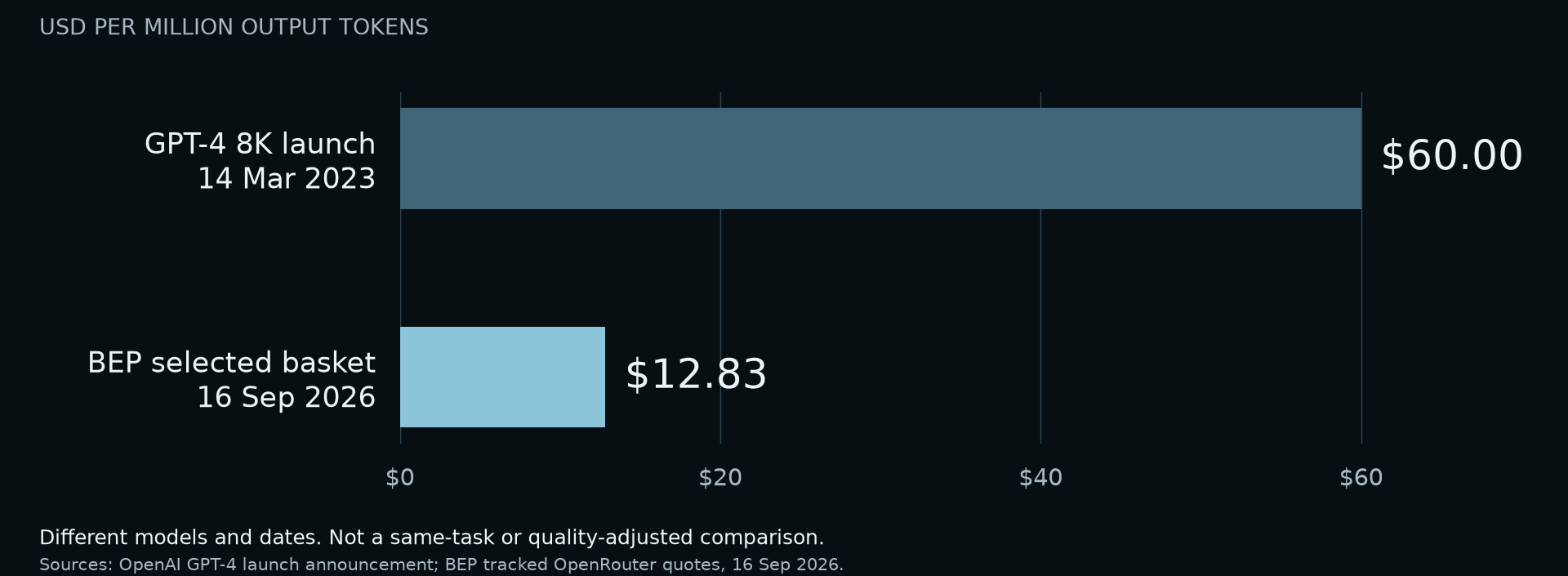
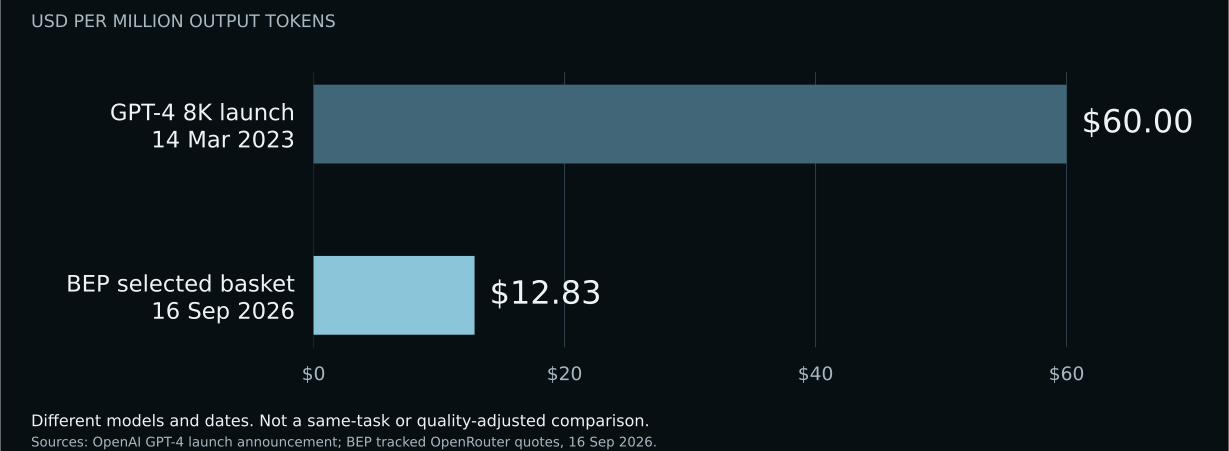
$60.00 versus $12.83 per million output tokens.
GPT-4’s 8K-context model launched on March 14, 2023 with an output price of $60 per million tokens. BEP’s selected price basket is $12.827 on September 16, 2026, displayed here as $12.83. That is about 79% lower in quoted output price.
These are different models and dates. This is not a same-task or quality-adjusted comparison, and does not show that a real workload became 79% cheaper.
From observation to decision
Measure the cost of accepted work.
For a defined workload, add input and output charges, retries, tool calls, and human review. Divide total measured cost by accepted results under the required quality and latency targets. That produces a decision-relevant cost measure; a token quote alone does not.
Then examine whether lower costs become customer discounts, provider margins, or additional usage. This chart supplies no direct evidence of demand growth, company profits, or investment returns. The next study needs repeatable task tests and permissioned customer bills.
Reproduce the number
What BEP selected on this date.
| Component / model | Weight | $/M output |
|---|---|---|
| OpenAIopenai/gpt-5.4 | 30% | $15.00 |
| Anthropicanthropic/claude-opus-4.6 | 25% | $25.00 |
| Googlegoogle/gemini-2.5-pro | 20% | $10.00 |
| DeepSeekdeepseek/deepseek-v3.2 | 15% | $0.40 |
| open-sourceopenai/gpt-oss-120b | 10% | $0.17 |
Fixed provider-priority selection; cheapest positively priced tracked named open-weight family for the final component. Observed weights are rescaled if components are missing. Not a newest-flagship guarantee or all-model average.
All five components are observed in this snapshot. The weighted sum is $12.827; dividing by the $60 reference and multiplying by 100 gives 21.3783 index points, displayed as 21.38.
- Different models and dates; not a same-task or quality-adjusted cost comparison.
- Output token quotes only; input, retries, tools, human review, caching and negotiated discounts are excluded.
- OpenRouter tracked list quotes are not necessarily vendor-direct or transacted prices.
- The comparison does not measure profit, demand or investment returns.
This is a dated briefing. The public live observation can change as later snapshots arrive; the source file for this briefing remains fixed.
Sources and text version
- OpenAI: GPT-4 launch announcement — original 8K output quote, March 14, 2023.
- OpenRouter model catalog — source of the tracked quotes, captured in BEP’s September 16 snapshot. Current catalog prices may differ.
- BEP’s dated selections and source record — captured 2026-09-16T10:49:50.962Z.
Read the briefing
A cheaper token is not the same thing as cheaper useful work.
GPT-four’s original eight-K output price was sixty dollars per million tokens.
BEP’s selected basket was twelve dollars and eighty-three cents on September sixteenth, twenty twenty-six.
Different models.
Different dates.
This is not a quality-matched benchmark.
It also does not prove that the same task became seventy-nine percent cheaper.
The basket uses fixed provider weights and a published selection rule.
It is not the whole market.
For an actual task, count input and output,
retries,
tool calls, and
human review.
Divide the full cost by accepted results,
holding quality and latency targets constant.
Then ask who keeps the savings:
customers, providers, or users doing more work?
This chart cannot tell us that.
That takes repeatable task tests and permissioned customer bills.
The dated chart, selections, and source notes are at BEP Research.
Follow the evidence with BEP.
Research connecting models, infrastructure, and the economics behind long-term investment.